

Learn About Rocks: The Rock Cycle
Earth is the ultimate recycler.
Underneath your feet, the ground isn't just a static platform—it is part of a massive, slow-motion recycling program that has been running for billions of years. Every pebble you pick up, every mountain range you climb, and even the sand on a beach is part of an epic journey of transformation known as
The Rock Cycle.
Rocks vs. Minerals: What’s the Difference?
Before we dive into the cycle, let’s clear up a common confusion. People often use the words "rock" and "mineral" interchangeably, but in geology, they mean different things.
- Minerals are the "ingredients." A mineral is a naturally occurring, inorganic solid with a specific chemical formula and a crystal structure. Examples include quartz, feldspar, or mica.
- Rocks are the "finished meal." A rock is a solid mass made up of a combination of different minerals.
Analogy time: If you were making chocolate chip cookies, the flour, sugar, and chocolate chips would be the minerals. The completed cookie is the rock.
The Three Main Players
All rocks on Earth fall into one of three categories, depending on how they were formed:
- Igneous Rocks: Formed from the cooling and solidification of molten rock (magma or lava).
- Sedimentary Rocks: Formed from the accumulation of dust, sand, and organic matter that settles in layers.
- Metamorphic Rocks: Formed when existing rocks are transformed by intense heat and pressure.
Shutterstock Standard License - Photo - 2710039561
The Rock Cycle: A Journey of Transformation
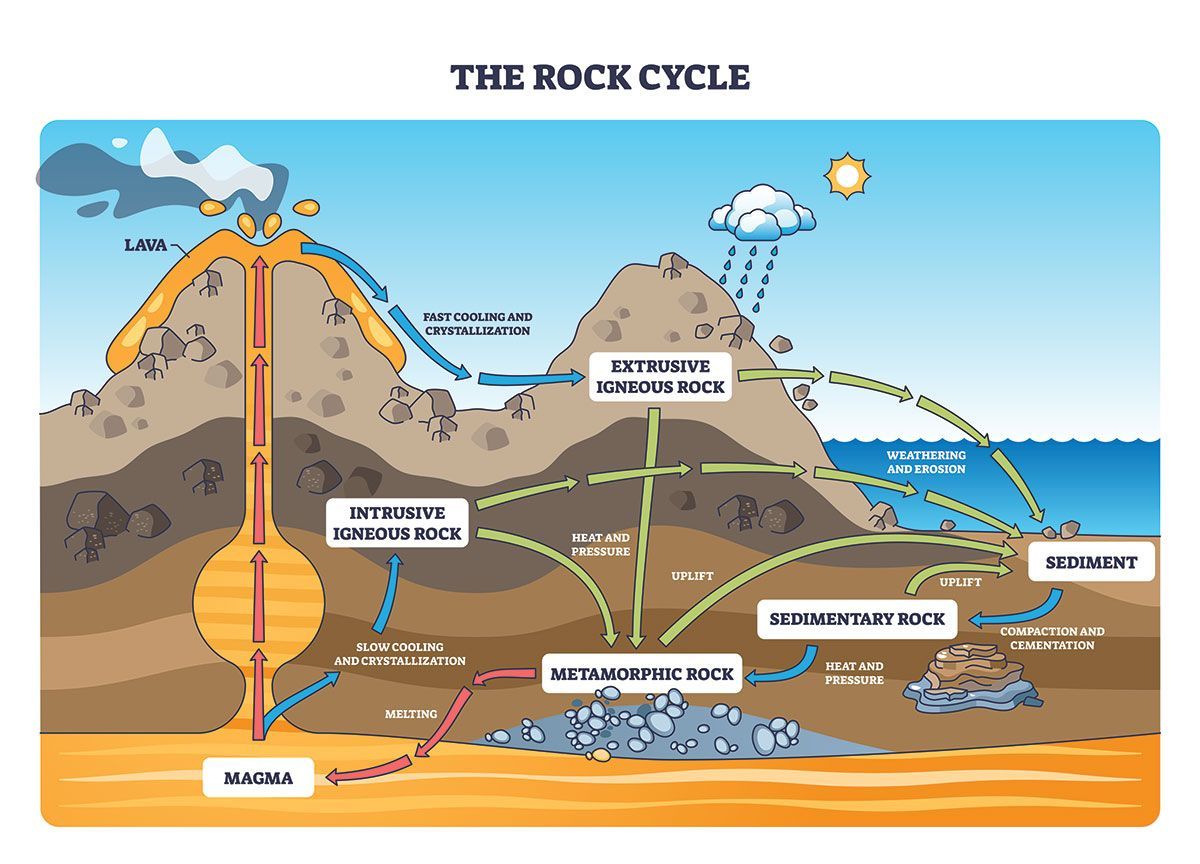
The "Cycle" refers to the fact that no rock is permanent. Through geological processes like erosion, melting, and tectonic pressure, one type of rock can become any other type.
How the journey works:
- From Magma to Igneous: Deep underground, rocks melt into magma. When that magma cools—either slowly underground or quickly after an eruption as lava—it crystallizes into Igneous Rock.
- From Igneous to Sedimentary: Once rocks are exposed at the Earth's surface, they face the elements. Rain, wind, and ice break them down into tiny pieces called sediment. These sediments wash into rivers and oceans, settling in layers. Over millions of years, the weight of the top layers squeezes the bottom layers together (compaction) and minerals act like glue (cementation) to create Sedimentary Rock.
- From Sedimentary to Metamorphic: When rocks are buried deep underground by tectonic plate movements, they don't melt, but they do get "cooked." Extreme heat and pressure change the mineral structure and texture of the rock without turning it into liquid, creating Metamorphic Rock.
- Closing the Loop: If the heat becomes intense enough, those metamorphic rocks will eventually melt back into magma, starting the entire process all over again!
Note: The cycle doesn't always move in a perfect circle. An igneous rock can skip the sedimentary stage and turn directly into a metamorphic rock if it gets buried deep enough!
Ready to dive deeper?
Understanding the cycle is just the beginning. To learn more about the specific characteristics of each type, explore our detailed guides below:
[Please see our pages on
Igneous Rocks,
Sedimentary Rocks, and
Metamorphic Rocks.]